By Ben Mattison interviewing Yale Law Professor Daniel Markovits, in Yale Insights, January 9, 2020 - Posted on February 12, 2020
[Editor's note: This column is posted as a noteworthy example of what passes for "thinking" on too many college campuses today, including the most "elite" institutions, including, in this example, Yale Law School, where subject of the interview is a tenured professor.]
In his book The Meritocracy Trap, Yale Law School’s Daniel Markovits argues that rather than democratizing American society, meritocracy has contributed to increasing inequality and the decline of the middle class. We asked him what it would take to create a society with opportunities for more Americans.
By Bud Morten, CT Mirror, Feb. 4, 2020 - Posted on February 9, 2020
Bud Morten debunks Sen. Cathy Osten
On January 19, State Senator Catherine Osten (D-19th District) published an op-ed in which she states: “There is some very good news happening in Connecticut right now,” and goes on to cite two recent reports from the State Office of Fiscal Analysis and the State Comptroller, both of which she claims are “full of good news” about what she calls “Connecticut’s financial rebound.”
Heavy attendance at last week's General Assembly hearing on the Lamont administration's plan to impose highway tolls on trucks suggested that most people realize that truck tolls are the first stage of a plan to impose tolls on all vehicles once the next election is out of the way.
Just as truck tolls are only the first step toward more taxes, defeating tolls is only a first step toward reforming state government. For state government never will examine its corruption, incompetence, and policy failures until the prospect of new revenue is foreclosed.
After the Connecticut General Assembly passed a billion-dollar tax hike in 2015, General Electric warned they might move their corporate headquarters out of the state if then-Gov. Dannel Malloy signed the bill. Malloy went ahead, and the following year General Electric announced the elimination of hundreds of jobs as they packed up the headquarters they’d called home for over 40 years.
That episode exemplifies a larger phenomenon happening across the United States over the last 10 years. According to population estimates for the end of the decade released by the US Census Bureau, millions of American families moved away from high-tax states to lower-tax ones, where work is rewarded and job creation is encouraged.
By Len Suzio, CT Post, Jan 23, 2020, Posted on January 24, 2020
The clock is winding down on Connecticut’s “Super Toll” debate and the Lamont team is running out of time to get their plan across the goal line. Desperate to get any points on the board before time runs out, Team Lamont unleashed a trick play in the form of a deceptive press release last Friday (Jan. 17). The press release was intended to mislead the public about the history of state government’s Special Transportation Fund and convince the public that during many years the General Assembly had to take billions of dollars from the General Fund to pay for transportation expenses.
From 2000 to 2015, the Legislature took in $4.1 billion of petroleum gross receipts taxes (one of the two state gas taxes you pay at the pump) and put all that revenue into the General Fund, and transferred barely half of it to the Special Transportation Fund.
By Red Jahncke, on The Red Line, on January 21, 2020
Compensation Exceeds Levels in Most Other States - in All Other States in Many Years
A conventional notion has taken hold that Connecticut's dangerously underfunded active and retired state employee health care and pension benefits are the result of past decades of under-funding. True, but that's a half-truth.
The other half of the truth is that state employee wages and benefits are outrageously generous. The average private citizen in the state earns significantly less and enjoys meager benefits in comparison. That's unfair in and of itself, but private citizens are hard pressed to fund such generous compensation with their significantly lower private sector compensation. That's both an additional unfairness and an almost unbearable burden which contributes to ongoing under-funding.
The president, however inadvertently, may be reminding the world of the reality of international relations.
A year
and a half into Donald Trump’s presidency, Henry Kissinger set out a theory. “I
think Trump may be one of those figures in history who appears from time to
time to mark the end of an era and to force it to give up its old pretences,”
he told the Financial Times. “It doesn’t necessarily mean that he
knows this, or that he is considering any great alternative. It could just be
an accident.”
A term
has been coined to describe this notion: Ryan Evans of War on the Rocks calls them “Trumportunities.” It
is the idea that, whether by accident or design, Trump creates chances to solve
long-running international problems that a conventional leader would not.
Through a combination of instinct,
temperament, and capriciousness, Trump may be reminding the world of the
reality of international relations: Raw military and economic power still
matter more than anything else—so long as those who hold them are prepared to
use them. The air strike that killed Qassem Soleimani was a reminder that the
U.S. remains the one indispensable global superpower. Iran, or indeed anyone
else, simply cannot respond in kind.
In other words, he who carries the biggest stick retains his dominance, so long as he is prepared to use it.
The argument for escalation is simple: If the response to any aggressive act by a foreign adversary is always to de-escalate in order to avoid a spiral of violence, then the advantage borne by military and economic dominance is lost, creating more chaos, not less.
Michael Stephens, a former British diplomat who is now a research fellow at RUSI, told me later that it was clear how badly the Iranians had been hurt, both in practical military terms and in pure national pride. “This has fundamentally changed the game and opens up the space for de-escalation,” he said. “It was a sucker punch which has scrambled their understanding of how the Americans might react in future. In the short term, it’s a triumph for Trump.”
By Chris Powell in Republican American - January 11, 2020 ---- Michael E. Miller in The Washington Post - September 22, 2019 --------- Posted on on January 15, 2020
Illegal Immigrants Crowd Schools in Norwalk, CT & Worthington, MN
Norwalk, CT, by Chris Powell - Republican American
Connecticut should welcome immigrants, Gov. Ned Lamont and the politically correct crowd say. But they fail to distinguish between legal and illegal immigrants.
Lamont and his P.C. posse should have attended the Nov. 26 meeting of the Norwalk City Council.
Superintendent Steven Adamowski explained the school system’s need for an emergency appropriation of $1.4 million to accommodate about 370 students who came to the city unexpectedly in recent weeks, most of them illegal immigrants from Central America.
Most of these new students, Adamowski said, don’t speak English, and many have had little education, so they will be expensive to teach. The city may have to build another school.
The council approved an emergency appropriation of $400,000 for the city’s social-services department, which faces extra work with the immigrant students and the families they’re staying with.
Will state government reimburse Norwalk for its sudden extra expenses arising from illegal immigration? If so, where in the state budget will the money come from? With the state’s economy declining amid ever-increasing taxes, just how much more illegal immigration should Connecticut welcome?
Worthington, MN, by Michael Miller - The Washington Post
Worthington, a community of 13,000, has received more unaccompanied minors per capita than almost anywhere in the country, according to data from the Office of Refugee Resettlement (ORR).
Their arrival has helped swell Worthington’s student population by almost one-third.</p?
Five times in just over five years, the district has asked residents to approve an expansion of its schools to handle the surge in enrollment. Five times, the voters have refused — the last time by a margin of just 17 votes. A sixth referendum is scheduled for November.
“The school district is busting at the seams,” added Mayor Mike Kuhle.
School districts don’t track immigration status but they do keep tabs on English language learners (ELL), who are generally more difficult and costly to educate.
The number of ELL students in Worthington has nearly doubled since 2013, to 35 percent of students. In the high school, where most unaccompanied minors are placed, it has almost tripled.
In the 1960s, Worthington was almost entirely white. But by the end of the century, the population was 20 percent Hispanic: primarily Mexicans drawn to the area’s poultry farms and meatpacking plant.
In 2007, Immigration and Customs Enforcement arrested more than 230 undocumented workers at the plant. Immigrants kept coming, however, mostly from Central America. Today the town is almost two-thirds minority. Hispanics outnumber whites.
Even as Worthington has changed, however, its tax base still depends largely on white farmers.
In 2013, when the school district first asked voters to pay for new classrooms amid the influx of unaccompanied minors, those farmers feared they would bear the brunt of the $39 million. The bond referendum failed.
Three years later, the school district asked for $79 million. The request was defeated by a 2-1 margin in 2016.
Attitudes have only hardened since then, as three more referendums have failed.
[A $34 million school bond was approved by 19 votes on November 5, 2019.]
By Editorial Board, The Wall Street Journal, Jan. 7, 2020 -- Posted on January 13, 2020
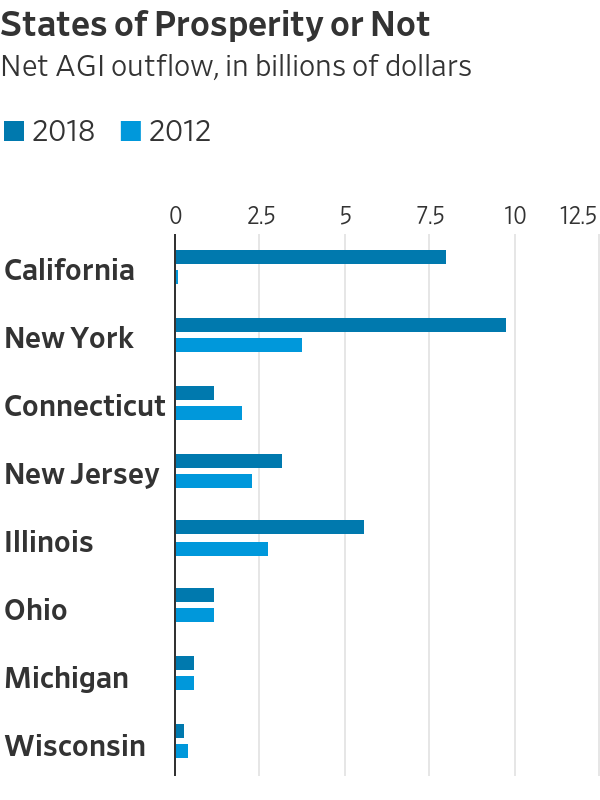
The U.S. population grew last year at the slowest rate since World War I as the birth rate and immigration declined, the Census Bureau reported last week. Slowing population growth will have significant economic and social implications for the country, but especially for high-tax states.
The Census Bureau and IRS last week also released state population growth and income migration data for 2018 that show the exodus from high-tax to low-tax states is accelerating. Four states have lost population since 2010 including West Virginia (-3.3%), Illinois (-1.2%), Vermont (-0.3%) and Connecticut (-0.2%), but 10 experienced declines last year. New York was the biggest loser as a net 180,000 people left for better climes. Over the last decade New York has lost more of its population to other states (7.2%) than any other save Alaska (8%), followed by Illinois (6.8%), Connecticut (5.6%) and New Jersey (5.5%).
By Philip Klein, Washington Examiner, 1/7/20 10:34PM, posted here on January 8, 2020
Should the missile attack on Iraqi bases housing U.S. troops turn out to be the extent of Iran's response, then the operation to kill Iranian terrorist leader Qassem Soleimani will turn out to be a major victory for President Trump.
Though the Pentagon has yet to release a full damage assessment, preliminary reports suggest that Iran's action resulted in no U.S. casualties. Iranian officials are now claiming that they have no interest in further escalation if the United States does not retaliate. This could be it.
If this is indeed the case, there is no doubt that the U.S. dealt a far more devastating blow to Iran than it absorbed in return.