
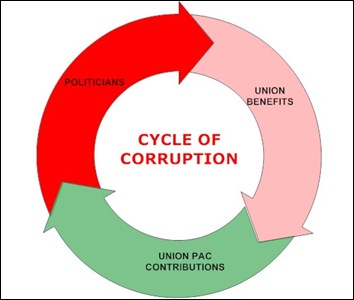
I write often about Connecticut state employee compensation, which is the highest in the 50 states. Wages have increased 33% under Governor Lamont, rising to second highest rank. Pensions are so generous that some pensions exceed final salaries. Health care coverage ranks consistently as most generous.

Readers ask whether I get hate mail from state employees. No, not until I received a recent diatribe from a worker in Dept. of Corrections, Mr. X.
First, Mr. X challenged the calculation of the 33% wage increase. The calculation combines annual general wage increases (GWI) and 2% for “step increases” (aka “annual increments”) that individual employees receive in varying amounts at different times as they rise in the state wage structure. Two percent is the workforce-wide average step used by state budget agencies.

Under Lamont, there have been two 5.5% raises (GWI plus average 2% step), then four 4.5% raises.
Mr. X asserted that he received “money in my paycheck over the last six years of 2.5% raises that only equals 15% cumulative,” lowballing the first two raises and not including any step increases, saying steps go only to “less senior officers who are gaining experience in the job.”
State employee wages are publicly disclosed on the State Comptroller’s OpenCT website. I looked up his wages, which included two annual 3.5% GWIs and four annual 2.5% GWIs as well as mid-year increases of 2.6% and 3.8%, which could only have been step increases. OpenCT showed him as a senior officer with 17 years of service (YOS) at the end of the six years, during which his wages increased about 26% from about $56,000 to $71,000.
Actually, I didn’t have to look up his data, because he had appeared in the recent Study of overtime (OT) and OT spiking commissioned by Nutmeg Research and Yankee Institute and conducted by The Townsend Group, which I head. Overtime spiking is working extremely long hours of overtime in order to increase pension benefits. Most senior Connecticut state employees can include overtime in the calculation of their pension benefits.
The Study identified ten Corrections workers (some guards and some nurses) with the highest overtime pay in each the five fiscal years of 2020 through 2024. Mr. X appeared on the top-ten list in three of the five years.
In the four fiscal years through 2024 (his 14th to 17th YOS), he earned overtime pay approximately as follows: $138,000, $155,000, $156,000 and $97,000.
Almost all senior Corrections workers are eligible to retire after 20 YOS, and those hired before 2017 can include overtime in their pension calculation. At the 20th YOS, the pension calculation is about 50% of their three highest years earnings, according to the state’s pension actuaries.
If Mr. X retired today (assuming he had 20 YOS), his three-year average would be approximately $220,00 and he would receive a pension of roughly $110,000. That would be 55% higher than his final salary of about $71,000.
Mr. X defended his OT spiking saying “those earnings were during covid years where there was no staff either available or willing to work.” The Study did not analyze any impact of COVID or staff management practices in Dept of Corrections.
Then, he went on attack, saying “I looked you up and you make almost 200k typing a hate state workers article every once in a while.” Yet, The Townsend Group is a private for-profit concern. It does not disclose financial information.
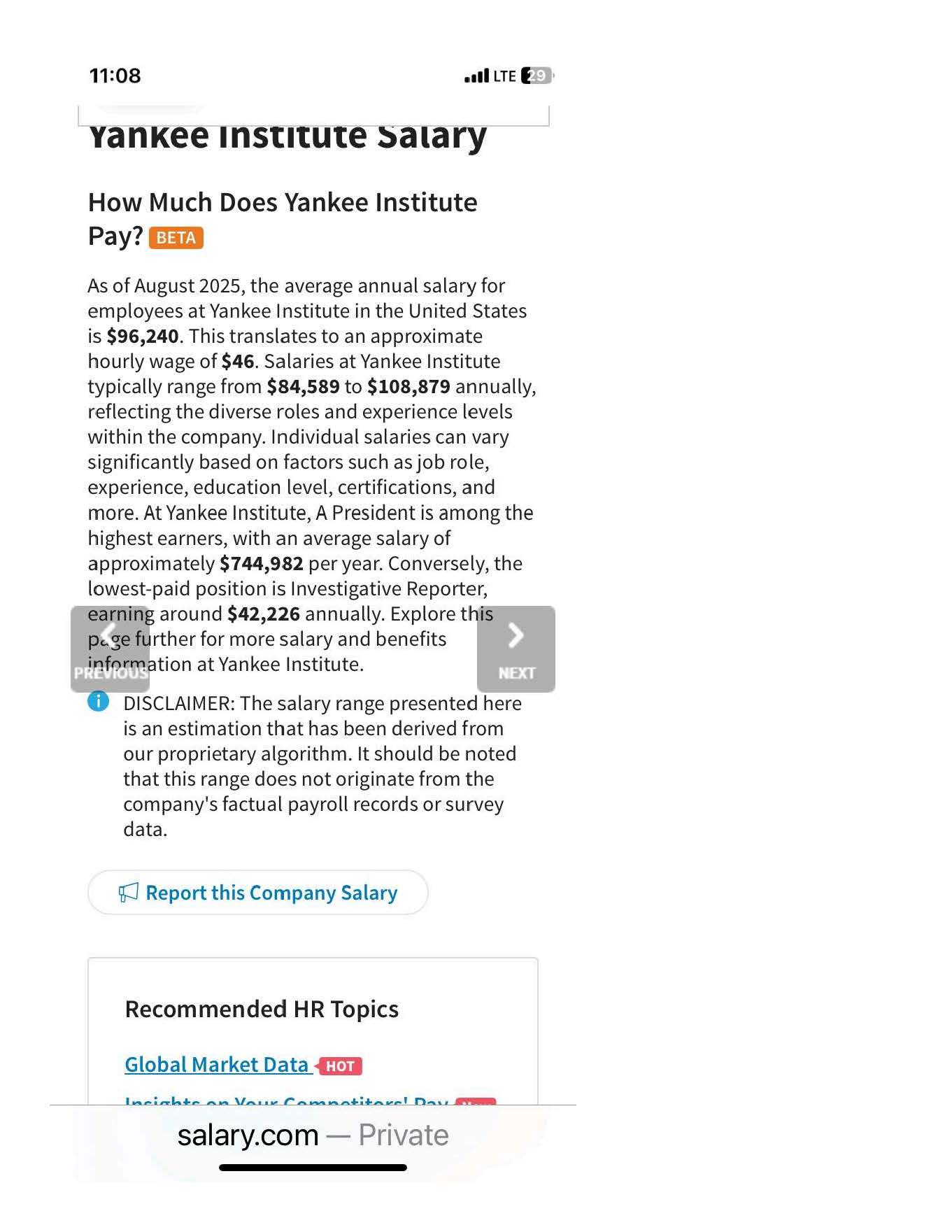
Mistakenly, he assumed that I work for Yankee Institute. He sent me information from Salary.com, which estimated that “Yankee salaries typically range from $84,589 to 108,879” (not “almost 200k”). Based upon its “proprietary algorithm,” Salary.com estimated that Yankee’s president makes $744,982. As a non-profit, Yankee is required to file a Form 990 with the IRS, including compensation information, which showed Yankee’s president making $217,000.
Continuing his you-hate-state-workers accusation, Mr. X attacked me, saying “there was a German fella that targeted a certain group and touted hatred.”
That comment ended my interest in the email exchange. I concluded by requesting that he contact me, if any of the numbers in the Study about his compensation were wrong. He hasn’t.
Working in prisons is a tough and critically important job. Corrections workers should receive fair compensation, including fair retirement benefits. Yet, that does not include pensions higher than final salaries.
Nor does it excuse disinformation campaigns aiming to hide or distort the truth about state employee compensation. Mr. X’s vicious attempt to do so is the only direct personal attack I’ve experienced. Yet several times before, my columns have elicited push-back, both in union news alerts to members and in newspaper columns advancing distorted information. In one push-back column attacking one of my columns, the misinformation was so misleading that it brought forth three different letters to the editor from readers with direct knowledge of the facts.



Red Jahncke is a nationally recognized columnist, who writes about politics and policy. His columns appear in numerous national publications, such as The Wall Street Journal, Bloomberg, USA Today, The Hill, Issues & Insights and National Review as well as many Connecticut newspapers.