
Press "Enter" to skip to content

Posts tagged as “Column of the Day”

Public Unions Override Representative Democracy

Government cannot use union contracts to nullify government's basic obligations to the public,  a federal appeals court ruled last week in a case about the Connecticut state police union contract.

The contract had allowed troopers to prevent disclosure of misconduct accusations against them.

The court decision may be arguable law but its policy result is welcome. For the misconduct concealment provision in the state police contract is grotesquely subversive of democracy. Of course that is exactly how the government employee unions like it. For the unions, the less that is known about what they are extracting from the government, the better. The unions want the public kept ignorant.

The situation shouldn't have to get so complicated. Accountability in government is basic and there should be no obstructions to it. Connecticut's law letting union contracts trump the right-to-know law should be repealed and the unions should be reminded that they work for the public and not the other way around.

Unfortunately the public's control over its own institutions is being further curtailed throughout the country because of a loophole in federal military law.

While federal law prohibits unionizing by federal military personnel on active duty, the prohibition doesn't apply to members of state units of the National Guard that have not been called to federal service. So last month the U.S. Justice Department conceded to a lawsuit brought in Connecticut on behalf of National Guard members seeking to unionize.

This settlement is an invitation to unionization by National Guard members in every state.

Unionization may devastate the chain of command in state militias. So Congress should extend to state National Guard units the ban on unionization and Governor Lamont and the General Assembly should enact such a prohibition for Connecticut.

Read in Journal Inquirer

Read and comment here on on The Red Line

Letter to Editor of The Wall Street Journal

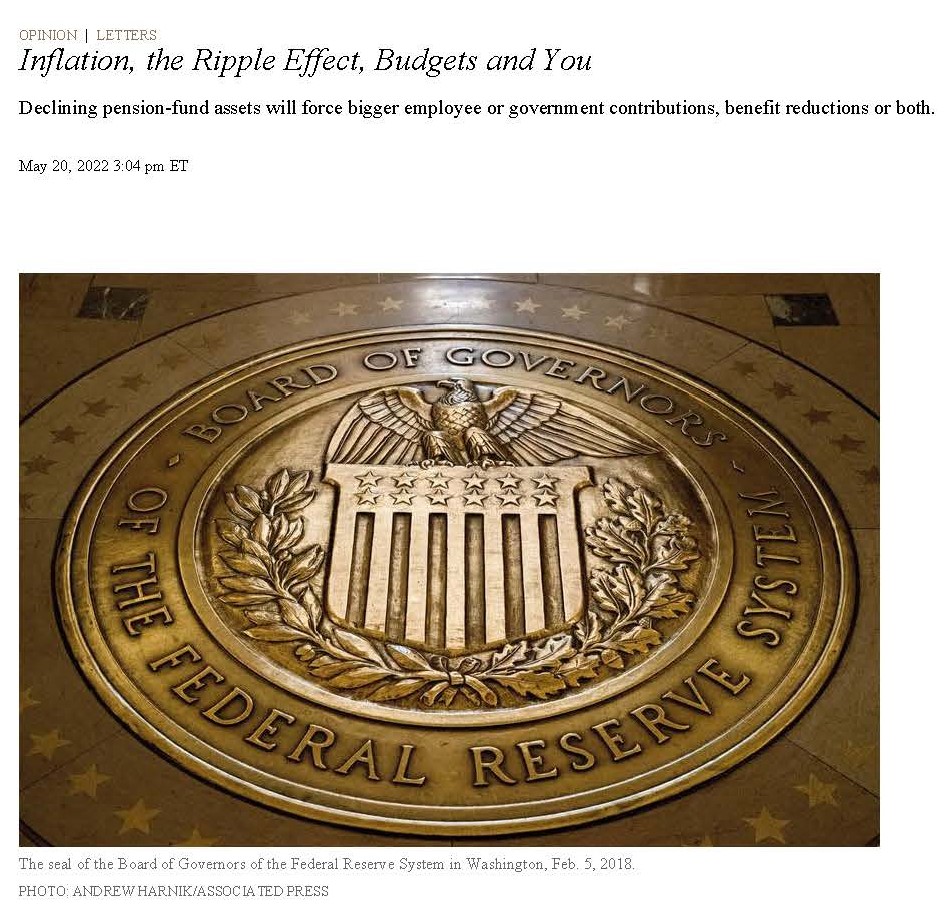
Red Jahncke hits the nail on the head: “Falling Markets Will Crush Government Budgets” (op-ed, May 17). He emphasizes declining tax revenues, but the fall in the markets will have at least two other major adverse budgetary impacts worth noting.

First, tens of millions of Americans are receiving income from pension funds... For state and local governments, where many pension funds are already only around 70% funded, this will force bigger employee or government contributions, benefit reductions or both. 

Second, rising interest rates are going to sharply increase the interest payments of the federal government to bondholders.

Read in Wall Street Journal

Read and comment here on The Red Line

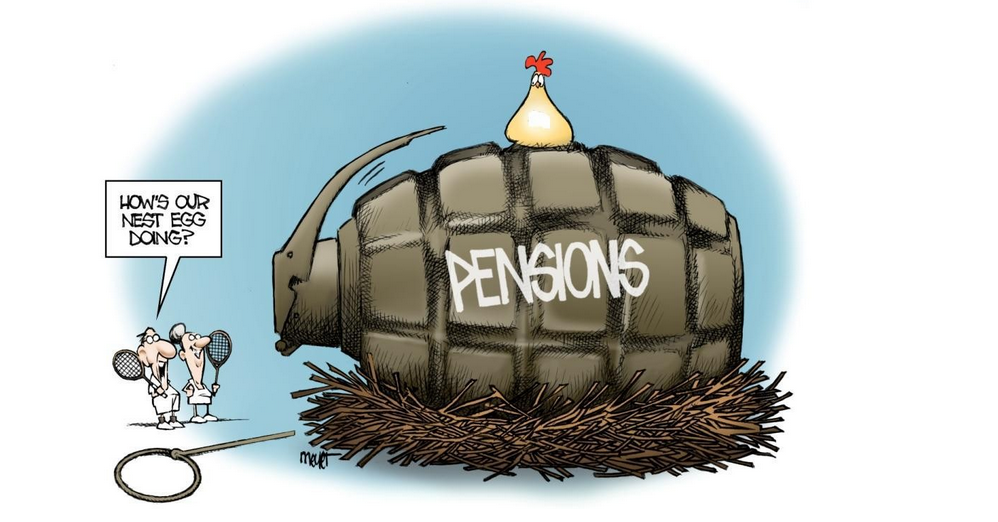
Falling Markets Crush Public Pensions

State and local government retirement funds started the year with their worst quarterly returns since the beginning of the pandemic. Things have only gone downhill since.

May 10, 2022

Losses across both stock and bond markets delivered a double blow to the funds that manage more than $4.5 trillion in retirement savings for America’s teachers, firefighters and other public workers. These retirement plans returned a median minus 4.01% in the first quarter, according to data from the Wilshire Trust Universe Comparison Service expected to be released Tuesday. Recent losses have further eroded their holdings.

Read in The Wall Street Journal

Read and comment here on The Red Line

Historic First: A 5’5″, 130-lb. Woman is Supreme Court Justice

Weird that the media didn’t cite Ketanji Brown Jackson’s height and weight, when it came to The First Black Woman on the Supreme Court. It was all about her race. But after a guy shot up a New York City subway car this week, the last thing the media wanted to tell us was his race.

For more than three hours after the attack, we got urgent alerts: Suspect at large! Police request public’s help! Be on the alert for a male, about 5’8″, 160 lbs.”

In this particular case, the media’s rule of never telling us the suspect’s race (unless he’s white) was more deranged than usual. This crime had all the earmarks of a terror attack — smoke bombs, fireworks, a gas mask, and about a dozen people shot while trapped in a subway car.

The police desperately needed the public’s help, but most people were looking for a Middle Easterner.

At least we knew it wasn’t a white guy! If it had been, reporters would have worn out the “W” on their computer keyboards. There would have been rampant speculation that it was a Proud Boy, as top administration officials reminded us that “white supremacy is the most lethal threat to the homeland today. Not ISIS, not al-Qaida — white supremacists.” (President Joe Biden June 2, 2021)

Read on AnnCoulter.com

Read and comment here on The Red Line

Does Gov. Lamont Know or Care What New Labor Contract Will Cost?

Anyone paying attention to state government last week might have been shocked by the disclosure from the state Office of Fiscal Analysis that Governor Lamont's proposed contract with the state employee unions will raise state government's labor expenses by nearly $2 billion over four years.

Announcing the contract six weeks ago, the governor said nothing about its likely cost. Had he even calculated the cost? Or did he care only about satisfying the state employee unions and mobilizing them for his re-election campaign and the campaigns of his fellow Democrats for the General Assembly and Congress?

Read in Journal Inquirer

Read and comment here on The Red Line

Unbalanced Interests: Tentative SEBAC Agreement

Through SEBAC, state government unions have reached a tentative agreement with the Lamont administration that will cost taxpayers millions. Guaranteed raises — along with a $3,500 bonus — will go out to over 40,000 state employees, regardless of performance. These are likely to be the same state workers who will be working hard for their favored candidate — calling your home, knocking on your door, or working the polls in the upcoming election. 

By law, negotiations between government unions and state management are supposed to be an adversarial process, with both sides advocating for their best position in order to strike an equitable balance of interests. Unfortunately, politicians have too often put their personal political objectives before taxpayers’ best interests in what amounts a betrayal of the public trust. 

Read in CT Examiner

Read and comment here on The Red Line

CT pays a high price to satisfy state employees

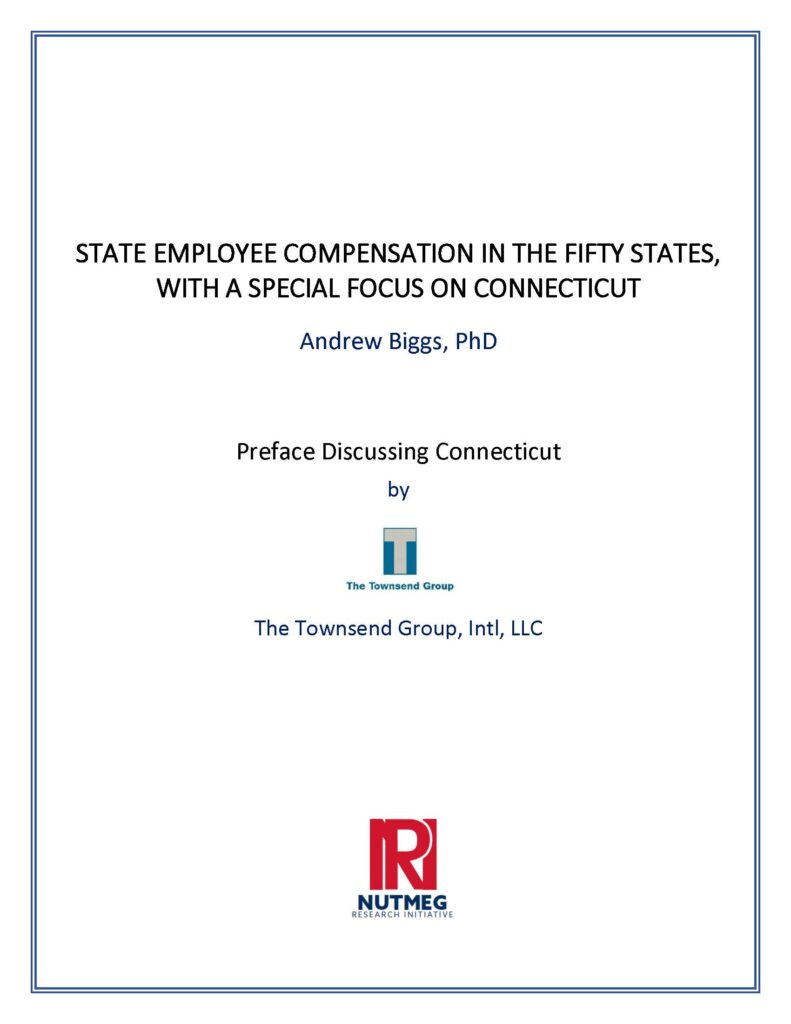
Another day, another study finding that Connecticut state employees are paid so much better than private-sector workers. The latest study was done by a senior fellow at the American Enterprise Institute, Andrew Biggs, who holds a doctoral degree from the London School of Economics.

Biggs' conclusion matches that of similar studies in recent years -- that the nominal salaries of state employees are a little smaller than those of private-sector workers in comparable positions, by about 6%, but their fringe benefits -- pensions and medical care -- are more than three times greater than what private-sector workers get, an average of $44,000 per year against $13,000.

Read in Journal Inquirer

Read and comment here on The Red Line

Connecticut Hits Its Taxpayers With a Huge Payoff to Unions

Gov. Ned Lamont said in 2019 he wanted “an anti-Wisconsin moment,” a jab at Gov. Scott Walker’s sweeping fiscal reforms of 2011. Instead, Mr. Lamont said, he wanted to “show that collective bargaining works.”

When unions representing most of the state workforce wrapped up their first round of contract talks with Mr. Lamont last month, the anti-Wisconsin moment arrived. Connecticut taxpayers are getting a costly reminder of who the process “works” for.

If Hartford lawmakers consent, state employees will pocket $2,500 bonuses, back pay averaging nearly $2,000, and raises of 2.5% to 4.5%. Another $1,000 bonus and more raises await in July, around the time their unions will decide whether to offer Mr. Lamont’s re-election bid the same intense backing they delivered in 2018.

Read in The Wall Street Journal

State Employee Compensation Study Author Briefs General Assembly Members Via Zoom

Editor's Note: This article contains mistaken interpretations of the study methodology.

First, there is no need for cost-of-living adjustment of the study results because state employees in each state are compared only to private sector employees in the same state.

Second, there is confusion of job descriptions, which the study does not compare, with employee characteristics, on which the study focuses. For example, judges can be compared to lawyers in private practice in terms of legal education and legal experience, etc. It is employee characteristics which have a market value, not the job.

A new study shows that Connecticut’s state employees receive the highest combined pay and retiree benefits nationwide – significantly more than what is earned in the private sector – and that the state has significantly underfunded those pension plans for more than a decade. 

“Connecticut’s high and severely underfunded state employee compensation leaves the state particularly vulnerable to adverse financial and/or economic conditions. It is in the interest of the state, its citizens and active and retired state employees to reduce this risk,” wrote Andrew Biggs, who authored the report, which was released in February.

Biggs, who has a PhD in government from the London School of Economics, is a senior fellow at the American Enterprise Institute, a conservative think tank based in Washington DC. The report was overseen by The Townsend Group International, LLC, a financial strategy firm in Greenwich, and commissioned by the Nutmeg Research Institute.

Biggs discussed the findings in his report during a Zoom conference call with a number of state representatives  — about 22 Republicans and three Democrats — that was hosted by Red Jahncke, president and CEO of The Townsend Group, on March 22. 

Read in CT Examiner

Read and comment here on The Red Line

The Corporate Real Estate Developers Behind Desegregate Connecticut

The topic of Transit Oriented Development (TOD) and the bevy of 8-30g proposed developments in Greenwich and other towns has clearly become an issue of focus. While adding affordable housing and TOD are laudable goals, to what extent it gets done and in whose hands it rests to determine that process is a very complex debate.

This led me to do some research on the main proponent for affordable housing in our state, a group called Desegregate CT. Below, I will present publicly available information about this group, and allow the readers to reach their own conclusions.

According to its website, Desegregate CT relies on funding and logistical support from a group called the Regional Plan Association (RPA), a New York City based non-for profit group. The Chairman of RPA, is also the CEO of RXR Realty which owns more than 30million square feet of residential and commercial real estate valued at over $22billion dollars.

The list of donors to RPA (available on their website) is weighted toward real estate and development companies. More than half of those listed as top donors of $100k or more are a who’s who in the real estate field; The Durst Organization, RXR, SL Green Management, Suffolk Construction, Related Properties, Cushman Wakefield, Edison Properties and others.

Read in Greenwich Free Press

Read and comment here on The Red Line