

We learned in April that average Connecticut state employee wages had topped $100,000. Now, three months later, average wages have surpassed $110,000. It is all part of Ned Lamont’s plan to assure his reelection.

In April, the U.S. Census Bureau published a 50-state study of salary and wages in state government as of March 2025. Connecticut ranked second-highest with an average wage of $101,500.

Later in April, Democrats in the General Assembly approved the new state employee wage contract (SEBAC 2026) that Lamont “negotiated” with union bosses. The contract provided for a pay raise of 4.5% for fiscal year 2026 to be paid retroactively and another 4.5% pay raise for FY 2027 to take effect on July first.
The two pay raises have now taken effect, taking average annual pay to about $111,000.
Averages can be meaningless. So, The Townsend Group, which I head, has undertaken two studies of the Census data on behalf of Nutmeg Research Initiative. Both studies focus on pay in different functional areas. In the first study, we followed the approach taken by Census which breaks down wages into as many as 35 different functional categories.
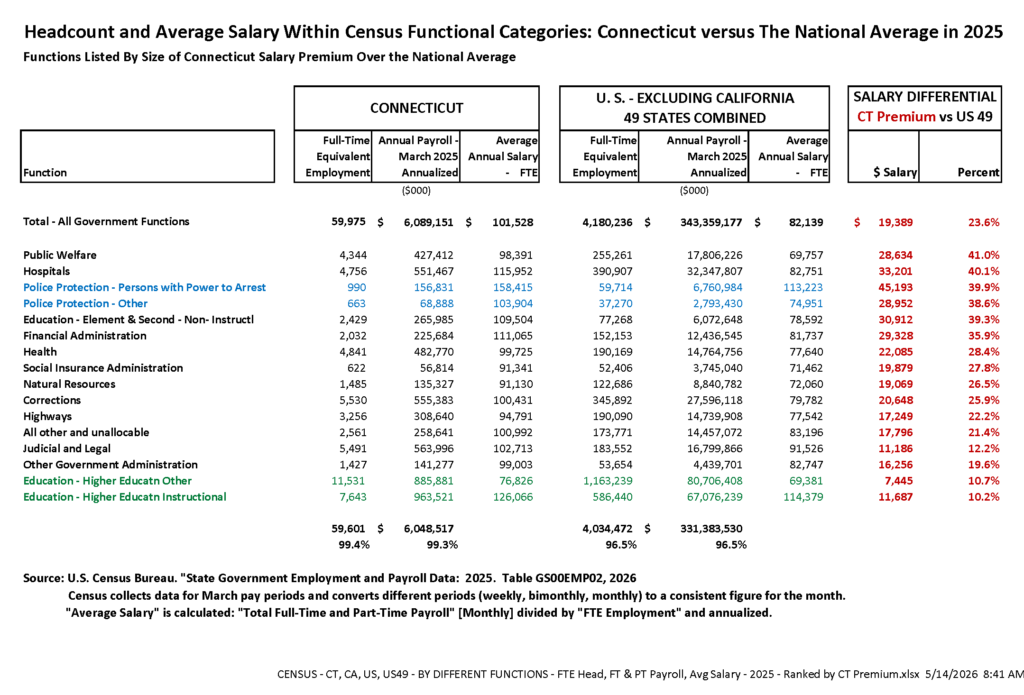
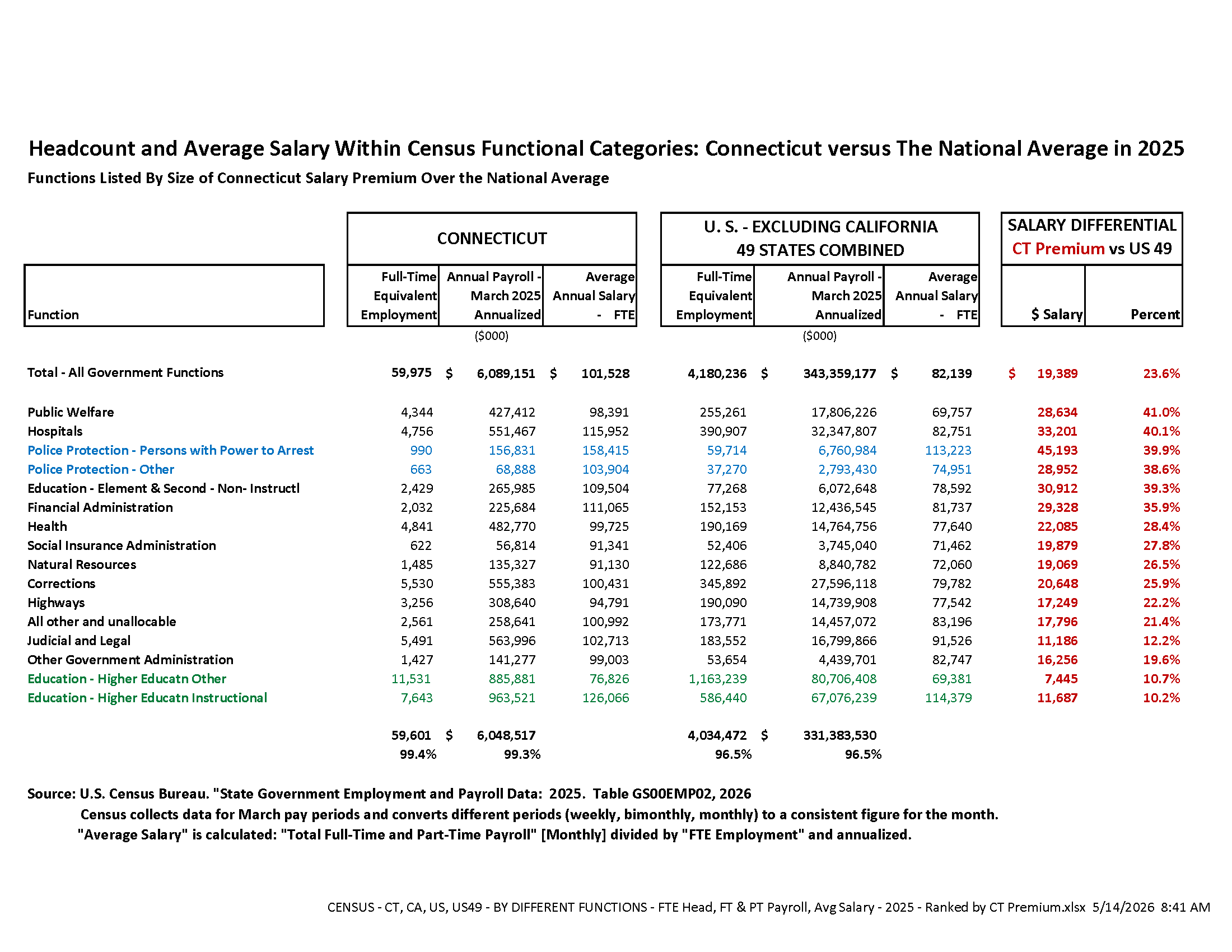
Fifteen Census functional categories cover over 98% of Connecticut’s aggregate payroll. Connecticut wages exceed the national average in every category, by amounts ranging from 10% to 40%.
In Townsend’s second study, we focused upon 11 categories accounting for over 90% of the state payroll. In each category, we calculated a ranking of the 50 states. Connecticut ranked first in two categories: Public Welfare and Financial Administration. Census confirmed informally that, in Connecticut, Public Welfare is comprised mainly of two agencies, Dept of Children and Families and Dept. of Social Services. Combined, these two agencies pay their employees an average of $98,400. That’s more than $28,000 or 40% higher than the national average of $70,000 for state workers in equivalent agencies in other states.
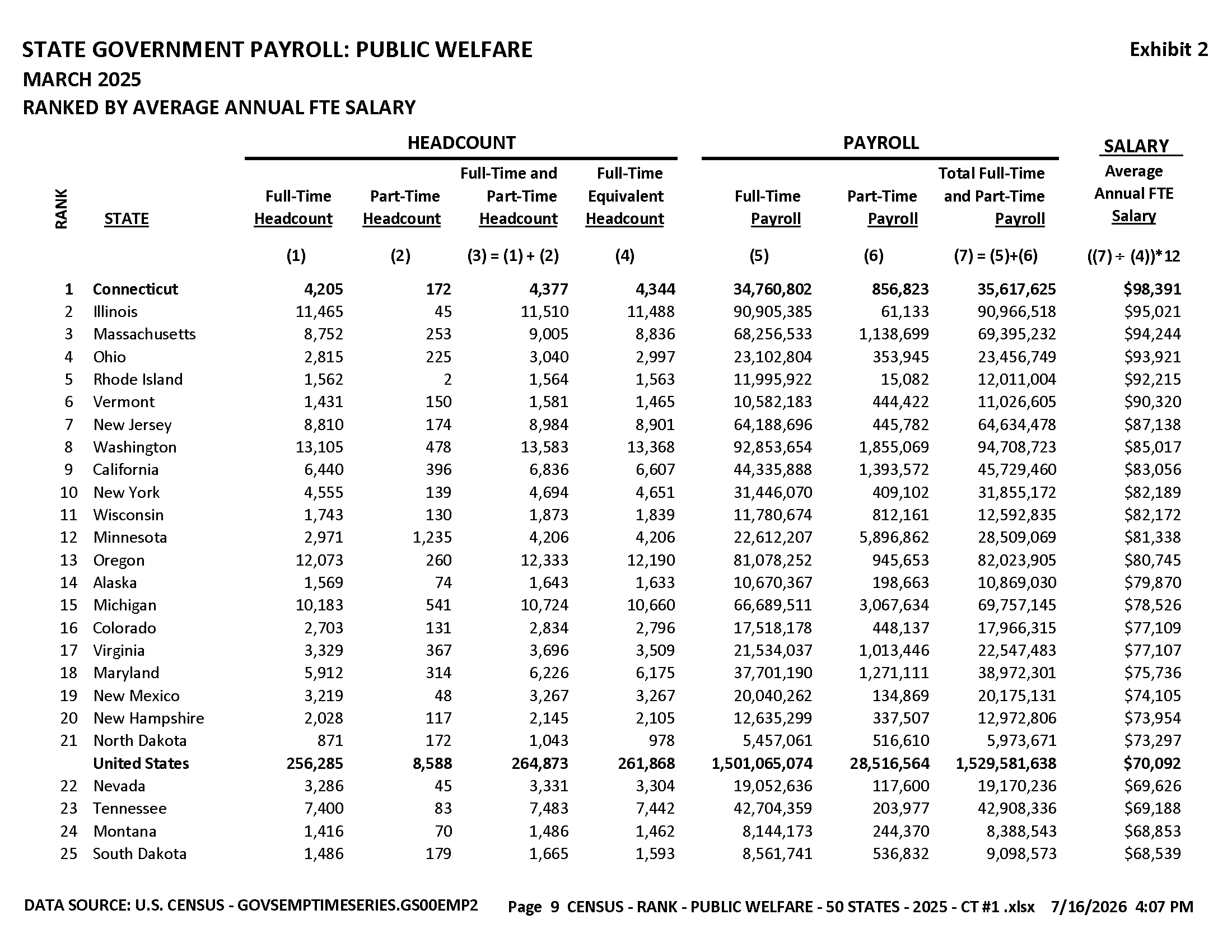
Pay in these two agencies is $4,000 higher than in our neighboring New England states of Massachusetts and Rhode Island, over $10,000 more than in New Jersey and more than $15,000 more than in New York State.
Do children in Connecticut suffer 40% more abuse? Are Connecticut families 40% more dysfunctional?
Alternatively, do DCF staffers do a 40% better job than peers in others states? Twenty deaths in 2025 and so far in 2026 of children with prior DCF case files would suggest not. That is not to say that DCF social work is easy or that DCF staffers are uncaring, incompetent or corrupt. But it is to say that they are grossly overpaid.
In the Dept of Social Services, staffers primarily distribute federal welfare benefits, e.g. food assistance (SNAP) and winter heating assistance. Is it more difficult to distribute these federal benefits in this state than in others?
Then, there’s Financial Administration. Are the tax and spending numbers in highest-paying Connecticut so much more difficult to tumble than those in other states?
Our state police department, with an average annual salary in March 2025 of $136,500, ranks third among state police departments nationwide. Department employees are paid about $35,000 more than the national average.
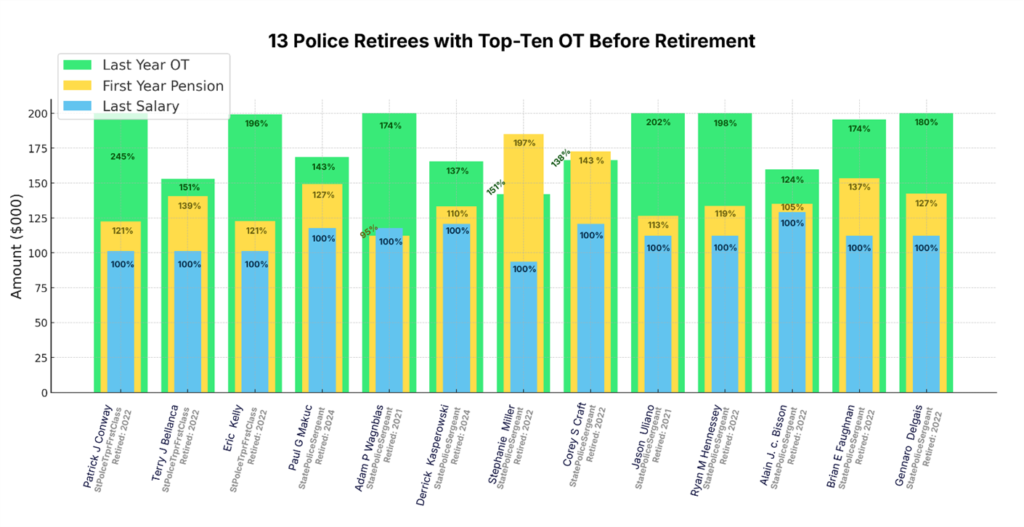
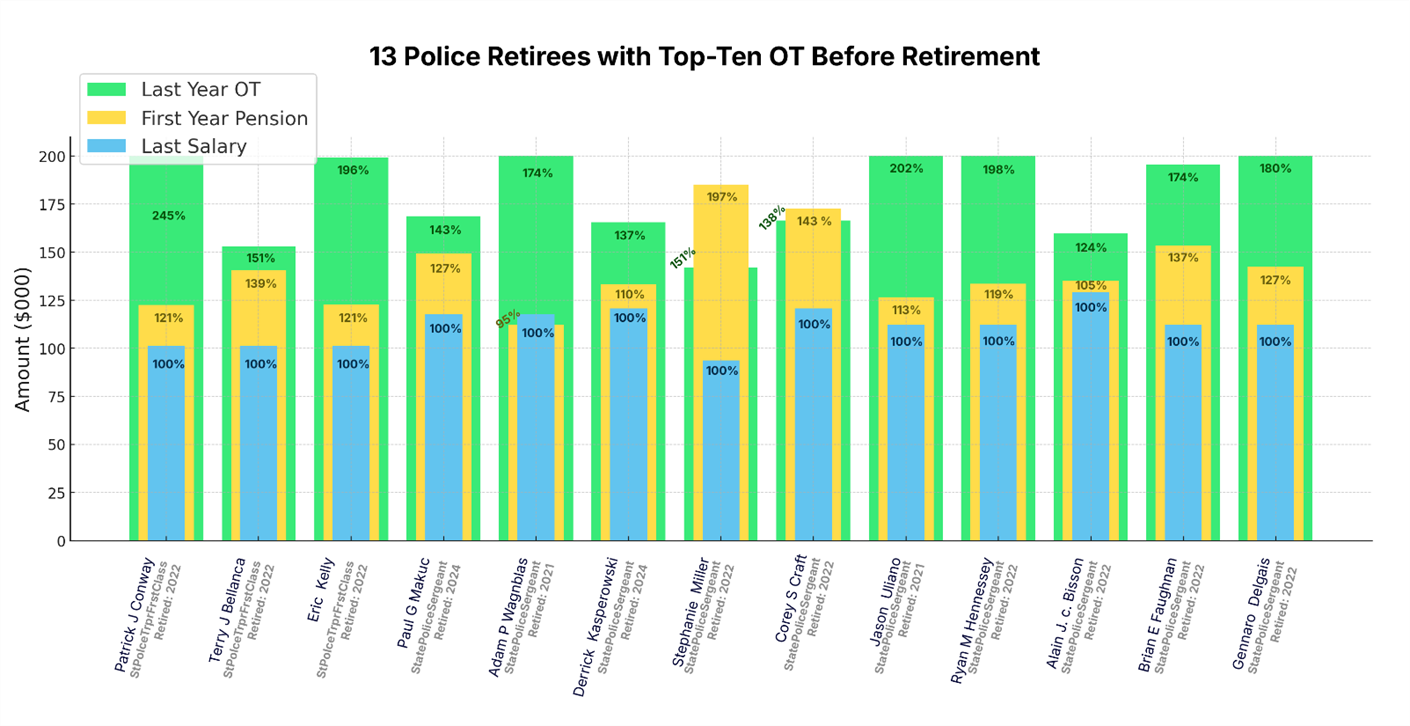
And that brings us to another Townsend study. A year ago, we found that state police are retiring with beginning pensions that are 34% higher than their last salary. State police come by this eye-popping benefit by working massive amounts of overtime, which is includable in the earnings base used to calculate the pensions of policemen hired before 2017 (of whom, there are many). The calculation base is those years with the highest earnings, usually those just before retirement. The same behavior prevails in the Department of Correction, yet with wages ranking only eighth-highest nationwide.
Logically, the only way that a police or corrections officer about to retire can work massive amounts of overtime is some combination of two factors: (1) understaffing and (2) the practice of steering overtime to those about to retire. The latter requires either management complicity or fellow officers’ cooperation, or both.
With the third-highest salary in the nation, it cannot be difficult to hire state police officers, and only slightly less so correction officers. Both jobs are difficult and dangerous, but those same jobs are performed by workers in other states for far less pay. Yet, when questioned, Lamont has said “I have a hard time hiring.”
The solution is easy. Pay a signing bonus to new hires, not a general pay raise that supercharges the compensation of pre-2017s even more.
There’s only one hiring problem that grossly overpaying state employees addresses: whether voters will hire Lamont again in November. Lamont is buying votes, first, those of state employees, their families and friends. Secondarily, he is making sure that state employees will man the phones to get out the vote. Having landed a fat new contract, union bosses will make sure that union members man those phones.



Red Jahncke is a nationally recognized columnist, who writes about politics and policy. His columns appear in numerous national publications, such as The Wall Street Journal, Bloomberg, USA Today, The Hill, Issues & Insights and National Review as well as many Connecticut newspapers.