
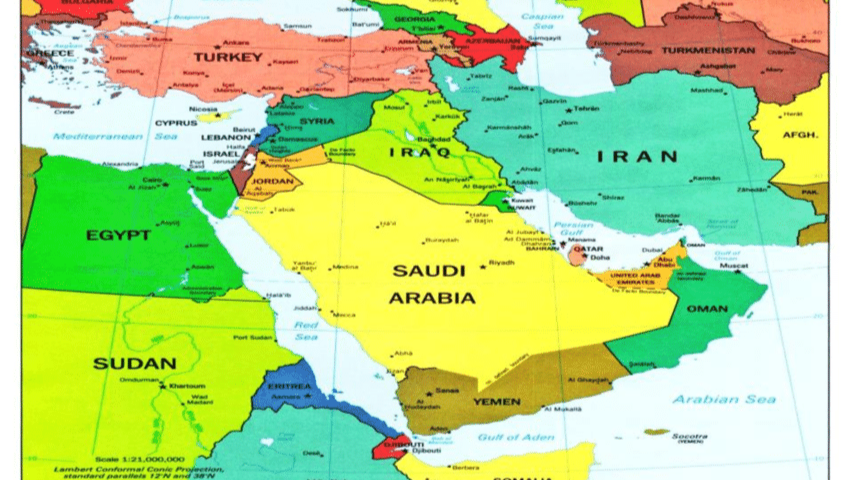
The likely outcome of the Iran War is a draw at best. Yet, President Trump could achieve much more. In high irony, the conflict has revealed that Iran may not need a nuclear weapon. Closing the Strait of Hormuz has emerged as Iran’s non-nuclear weapon of mass destruction. With some diplomatic pressure and ingenuity, Iran might be induced to swap nuclear for non-nuclear.

This swap could serve as the basis for settlement of the entire Mideast conflict.
Trump could induce Iran to give up its entire nuclear program in return for the establishment of a Palestinian homeland (not state) in the West Bank and Gaza overseen by U.S. and Arab armies. He could sweeten the deal with a plan for the U.S. and Iran together to patrol and toll the Strait, an idea that the President recently half-embraced half-seriously. The toll receipts would be devoted to the massive cost of regional reconstruction, for which there is no other apparent source of funding.

Iran’s implicit public posture throughout the decades-long conflict has been that it needs a nuclear bomb as an umbrella under which to attack Israel to advance the Palestinian cause, a cause that most of the world supports. Establishment of a Palestinian homeland would finesse this posturing, genuine or fake.
Skeptics say the posture is fake, that Iran only exploits the Palestinian cause to justify attacks on Israel and to foment regional mischief. Let’s stipulate that the skeptics are right. Does the difference matter? If the Palestinians get a homeland, it would strip the Mullahs of the only justification for their behavior that the world respects.
It would strip the resistance of its support. Why would Gazans support Hamas, if Gaza is genuinely free? Why would Hezbollah attack Israel, if the West Bank is liberated? Why would the Houthis launch more missiles?
Moreover, it would address the legitimate cause inspiring most of the world’s younger generation. The overwhelming majority of young people are offended deeply by Israel’s harsh occupation and oppression of the Palestinians. A homeland free of the Israel Defense Forces would address that legitimate grievance. The young should not be ignored. They will accede to power sooner than later.
If the conflict has defied resolution for almost a century, what is now the game changer? It would be the willingness of the U.S. to become directly involved on the ground, along with troops from Arab nations, primarily from with those peace agreements with the Jewish state.
The odds are long, but there is a plausible path to the creation of an international protectorate in the West Bank and Gaza. In Gaza, a short-term version of an international protectorate has already been adopted as the consensus day-after plan. Why not expand it to the West Bank and extend it long-term?
Related Content: A Palestinian Protectorate Overseen by U.S. and Arab Armies
Direct third-party involvement is the key. Over the entire sad history of “two-state solution” effort, the U.S and other third parties have encouraged the two parties to agree between themselves on a two-state solution, while not being willing to get involved directly in the solution. The result has been a semantic dance about sovereignty.
Israel’s conception has been to offer a “state” to the Palestinians, but retain security control over the entire area. The Palestinians have accepted a demilitarized state, but, obviously not the continued presence of the IDF. With the IDF remaining in the West Bank, how would this be different from the status quo? Yet, how could Israel cede security to people who have sent suicide bombers into Jerusalem and launched the massacre on October 7th?
Third-party failure to become directly involved has left the conflict to rage. Constant violence has prevented a solution, and the absence of a solution has perpetuated the violence — in a cycle of ever escalating conflict.
Now, every nation in the entire region has been drawn directly into the conflict, and the ongoing risks are existential and the damage catastrophic. Gaza is rubble, as is southern Lebanon. Gulf state oil production facilities and other infrastructure are severely damaged. Iran’s industrial infrastructure has been largely destroyed.
The costs of recovery will be astronomical – well beyond the means of the U.S., with our national debt now over $30 trillion.
Wealthy Gulf sheikdoms cannot reprise 1991 when they paid most of the military cost of the Gulf War. Their damaged oil production facilities require expensive repairs. The U.A.E. has already requested financial aid from the U.S.
If not the U.S. or the wealthy Gulf states, who will pay to rebuild? Without rebuilding, the situation will only fester. Cobbling together a group of nations would be difficult to impossible. Why not let the market pay? Why not toll shipping passing through the Strait? The “invisible hand” would take money evenhandedly from the pockets of all those transiting the Strait.
Nothing could heal the wounds of the war faster than the two principal combatants cooperating in the tolling venture.
After four wars in the Mideast – the Gulf War, Afghanistan, Iraq and, now, Iran – Americans are sick of the escalating viscous cycle. If we are going to protect Israel, we should do it in a way that settles the overall conflict once and for all and prevents a fifth war, a sixth…
An overall settlement with the creation of a permanent protectorate for the Palestinians is more possible and more urgent than ever before and still the preferred outcome. It may not be likely, but only an unorthodox leader like President Trump would attempt it. If he achieved it, who wouldn’t applaud vigorously?



Red Jahncke is a nationally recognized columnist, who writes about politics and policy. His columns appear in numerous national publications, such as The Wall Street Journal, Bloomberg, USA Today, The Hill, Issues & Insights and National Review as well as many Connecticut newspapers.