

Governor Ned Lamont may not make it to the general election in his bid for a third term. His Democrat primary opponent, progressive Josh Elliot, just released a very compelling political advertisement, suggesting an aggressive campaign against Lamont, a self-described “moderate.”

Progressives across the nation are having their moment. Democrat socialists like Elliot have upset even liberal Democrat incumbents in multiple recent primaries, most notably in neighboring New York City. Progressives are energized. They will turn out big in the state’s August primary.

The Democrat power structure, aka public sector unions, may be having heartburn after just endorsing Lamont over Elliot at the recent AFLCIO convention. The union bosses may have to call members back from August vacations to rescue Lamont.

An Elliot surge and a manifestly weakened Lamont is a huge opportunity for GOP candidate, Ryan Fazio.
Fazio has been planning to run on the general issue of affordability, and rightly so given all the high-cost, anti-business policies that Lamont, the unions and Connecticut Democrats have pursued with their super-majority, one-party rule. That was before the Iran war.
Now, the war has rekindled inflation and seriously worsened affordability for regular Americans. Gas prices may come down, but inflation won’t moderate before November. The tables have turned somewhat. Democrats will be able to hang some good share of unaffordability and an unpopular war around GOP necks.
Fazio needs a sharper angle. He has turned to property taxes, a perennial issue, and energy costs, an issue that Lamont has coopted by issuing state bonds to remove much of the public benefits charge from utility bills. Realistically, as potent as they once were, both issues have been well vetted. They won’t captivate voters. Nor the media. There’s a reason it’s called the NEWsmedia: only what’s new is newsworthy.
Actually, there is a potent new affordability issue for Fazio, about which he has already spoken quite eloquently: state employee over-compensation. State employees are represented by the most powerful unions in the country. The unions have made state workers the highest paid in the 50 states: the second-highest wages and the best benefits by far. This is a new issue, and one Lamont cannot coopt.
Related Content: Who’s Making $102,000… Headed to $121,000?
Lamont is snuggly in bed with the public sector unions, which have just outmaneuvered him for a new contract with four more years of wage hikes which, on top of the hikes during Lamont’s first six years in office, will deliver about a 60% increase over the decade through the mid-point of the third term that Lamont so desperately wants. Elliot’s fingerprints are also all over the new contract, since he introduced it and advocated for its approval in the State House.
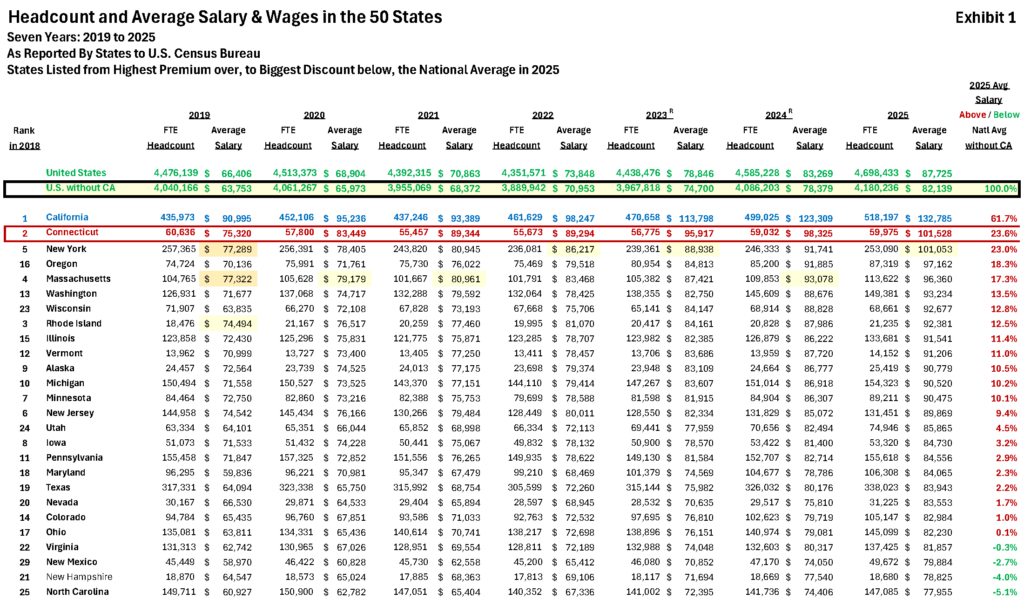
Recently released U.S. Census data reveals that, in 2025 before the new wage contract, Lamont was already paying Connecticut state employees an average wage of $102,000. That’s 16% higher than the average of the fifty states and ranks second behind only California. This has not escaped Fazio’s notice, who has commented colorfully “Don’t Californicate my Connecticut.”
Union bosses defend this largesse by saying Connecticut is a high-cost state, so members must be paid more. That is exactly backward: Connecticut is a high-cost state because union members are paid so much.
Connecticut is the most unionized state in the nation in state government. At the local level too, the state’s 169 towns struggle to pay high wages to unionized employees.
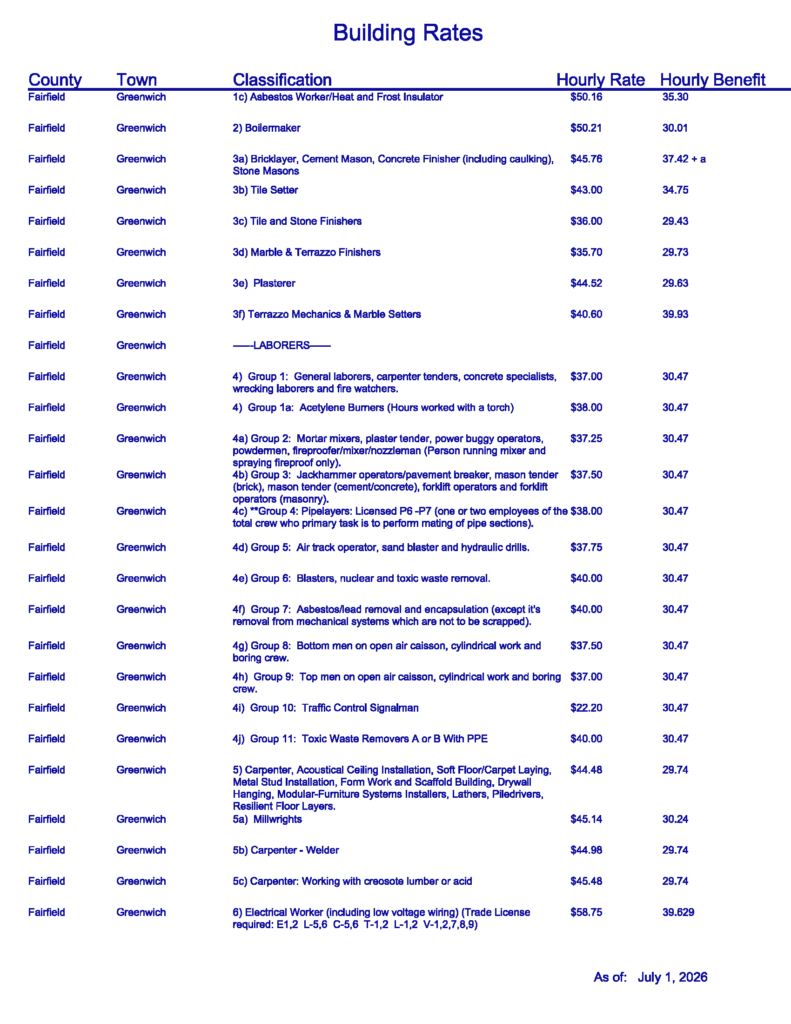
It is not just unionized public sector workers. The unions have forced Connecticut to adopt iron-clad high-cost prevailing wage laws, i.e. laws requiring all levels of government to pay “prevailing wages” to contractors on public projects.
In my hometown of Greenwich, there are 91 categories of workers, for each of which the state Dept of Labor calculates a required prevailing wage for public construction projects – think new school construction. It is not just wages, employers must provide “prevailing” benefits too. Talk about strangulating red tape. Eliminating the highest and lowest, the second-highest category in Greenwich must be paid $61 an hour in wages and receive $31 an hour in benefits; the second lowest, $22 in wages and $30 in benefits! Repealing the prevailing wage law and using conventional competitive bidding, such as done in 23 lower-cost states, would save ginormous amounts of money and reduce the state’s high cost of living dramatically. The unions and the prevailing wage laws are the real drivers of unaffordability.



Red Jahncke is a nationally recognized columnist, who writes about politics and policy. His columns appear in numerous national publications, such as The Wall Street Journal, Bloomberg, USA Today, The Hill, Issues & Insights and National Review as well as many Connecticut newspapers.