Press "Enter" to skip to content

Posts published in “Connecticut Newspapers”

Lamont Should KISS Off Taxes

Last week, Governor Lamont invoked the KISS principle (Keep It Simple, Stupid) to explain his reordering of the sequence of eligibility for COVID-19 vaccinations. He should not stop there. The entirety of state government could use a rigorous application of the principle.

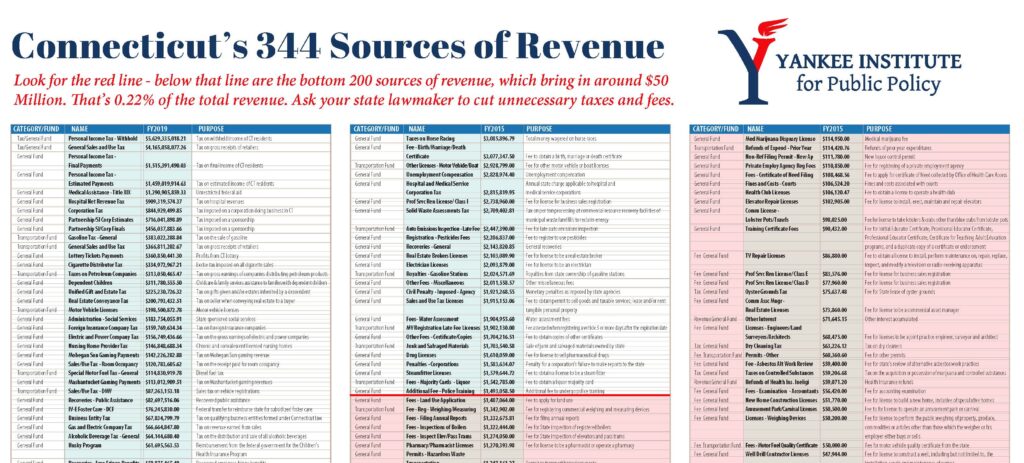
Last year, Yankee Institute released a study of state revenue sources. The study was simple. What it found was not. The study was just a one-page list of all the state’s revenue sources – all 344 of them.

Continue Reading:

Lamont’s Budget: Everything is “Capped,” Except State Employee Compensation

Governor Lamont unveiled his proposed Connecticut Comeback budget last week. A comeback is unlikely given the long-festering problem of overgenerous and woefully underfunded compensation for privileged state employees.

For over a decade, state employee compensation has exceeded compensation in Connecticut’s private sector by about 40 percent, the biggest gap in the nation.

The consequence is that the State Employee Retirement Fund (SERF) is drastically underfunded. It is difficult to fund such wildly overgenerous benefits.

What now is an ongoing gravy train for state employees is ultimately a train wreck for them and the state.

Continue Reading:

Schools Are Safe, If Not Havens from COVID

The evidence is piling up that schoolchildren, teachers and staff are safe in schools. Indeed, the evidence suggests schools are the “safest place” for them to be, as CDC Director Robert Redfield said last November. Yet, teacher unions and other school employee organizations are ignoring mounting evidence that support Redfield’s words.

Last week, the Centers for Disease Control released its first two studies of in-school spread of COVID-19, first, a study of the experience of 17 Wisconsin schools that operated in-person from August through November.

Continue Reading:

Martin Luther King in Connecticut

After a long summer of frequent violence and riots attending protests and after the recent horrific assault on the Capitol, it is especially meaningful to remember that non-violence was the bedrock of Martin Luther King's activism.

Remembrance is enriched by discovery of new previously unknown dimensions of the person or event. King spent college summers in Connecticut working on tobacco farms. It was the first time he ventured outside the Jim Crow South. He said it was an eye-opening experience.

Marvelously, high school students and teachers in Simsbury have just completed a years-long project to memorialize King's time in Connecticut. The CT Hearst newspapers have a wonderful article by Robert Marchant describing King's summers in the Nutmeg state and the Simsbury high school project.

Continue Reading:

Closing Schools Is A Cure Worse Than the Disease

Earlier this month, just days before the first Connecticut health care workers were administered the newly-approved coronavirus vaccine, a coalition of public school employee unions demanded Governor Lamont close schools - and extend all school employees a full-pay-no-layoff guarantee.

December 28, 2020

What a striking juxtaposition between the selfless dedication of health care workers who have been treating patients hospitalized with serious – and highly contagious – cases of COVID-19 for nine straight months and the selfish outlook of the 14,000 petition signers, who, only over the last three months, started again to interact with school-age kids, who present the lowest risk of transmission of all segments of the population.

December 30, 2020

To demand the closing of schools is tantamount to desertion on the field of battle. The top generals in this war -- Dr. Anthony Fauci, Director of the National Institute for Allergy and Infectious Diseases, Robert Redfield, Director of the Centers for Disease Control, and Surgeon General Jerome Adams -- have all said schools should be open. Fauci said this earlier this month even as the current surge of the virus was well under way.

January 4, 2020

School children themselves have virtually no risk from COVID-19. Of the 225,000 COVID-related deaths for which the CDC has demographic data, there have been only 130 school-age COVID-19 deaths, while 195 died of the seasonal flu during the 2019-2020 school year.

Schoolchildren do become infected. But do they spread the virus? That is a fair question for adult school employees.

Some studies published in the summer and early fall "suggest" that children may be "potential" spreaders, but they do not conclude that they are. Significantly, both Dr. Fauci and Director Redfield called for schools to be open after the publication of these studies, about which, presumably, they were aware.

Continue Reading:

Looming Crisis in Connecticut

Recent public announcements concerning Connecticut’s fiscal condition have come out in separate disjointed fashion. Taken together, they spell impending crisis.

October 12, 2020

It is no surprise that the state is facing an enormous deficit this year (and into the future), due, in part, to the sudden economic shutdown occasioned by the pandemic.

However, in larger part, the crisis has been long coming and widely anticipated. It is a function of the bill coming due for decades of paying state employees massively overgenerous, yet woefully underfunded, compensation. It is unlikely that Connecticut will have money both to continue state operations and to fund employee retirement benefits.

October 12, 2020

On the first of this month, Governor Lamont released his official deficit mitigation plan, as required after Comptroller Kevin Lembo made the obvious official, namely that the state faces a deficit of $1.8 billion in the current year’s budget of approximately $21 billion.

No one really knows where the state and the country are headed economically. The good news is that the state’s rainy day fund has grown to $3 billion since 2017. Lamont said he would use most of the fund to close the budget gap, leaving little for the next fiscal year and beyond.

October 12, 2020

Just days before, the governor announced his hiring of Boston Consulting Group to find $500 million in annual state savings, primarily from workforce attrition. The goal is to automate or eliminate many job functions, so that the expected retirement before mid-year 2022 of an estimated one-third of the state’s 49,000-person workforce will require the fewest possible replacements.

Of course, Lamont could have saved one-quarter of BCG's savings target by using his emergency powers to cancel the $135 million state employee pay raise last July 1st.

October 19, 2020

That would have caused employees little pain, as demonstrated by a recently released Yankee Institute study, which found that Connecticut’s state and municipal employees (excluding teachers) are paid about $20,000 per year more than their private sector counterparts. That translates into an aggregate annual premium of almost $1 billion for 49,000 state employees, assuming they and municipal employees enjoy equivalent pay.

Continue Reading:

Lamont Failed to Protect Lives and Livelihoods. Why Extend His Absolute Rule?

Governor Lamont has extended his emergency powers through February 9 of next year, despite his disastrous results so far in wielding those powers. Connecticut has sustained the fourth highest state death rate from coronavirus (126 per 100,000 citizens, according to Statista).

Does this record justify the longest extension of emergency powers in the nation? According to the National Governors Association, no other state governor has emergency powers extending into 2021 and only two are empowered even into December.

The challenge in exercising extraordinary executive authority is to limit the spread of coronavirus while inflicting the least possible economic damage.

Lamont has achieved a particularly poor balance. He has overseen an extremely high death rate, while imposing one of the strictest business shutdowns in the nation, undoubtedly with ultimately dire economic impact.

Lamont does not have the excuse of the three states with deadlier outcomes, New York, New Jersey and Massachusetts with their large densely populated urban centers. Connecticut is a suburban and rural state.

Continue Reading:

Facts About Police Behavior Matter

In his nomination acceptance speech, Democrat Joe Biden cited “systemic racism” as an established fact, despite that the evidence does not support that sweeping notion -- most significantly, not in policing. Such loose talk is incendiary.

This summer, the same talk raged inside The Wall Street Journal, eventually spilling into public view. Almost three hundred members of the News division signed a letter to Journal CEO Almar Latour alleging “lack of fact-checking and transparency and apparent disregard of evidence” in the Opinion division, primarily concerning the early June publication of an op-ed by Heather Mac Donald entitled The Myth of Systemic Police Racism.

In the interest of full disclosure, The Journal’s Opinion section has published several of my opinion columns.

Each word in the headline of Mac Donald’s op-ed is important. The title does not call police racism a myth, just systemic police racism. It does not say there are no racial differences, or disparities, in policing.

The headline frames assertively, but fairly and accurately, the column’s central statement that “a solid body of evidence finds no structural bias.”

The News department accused Mac Donald of “cherry picking” a study by Harvard economist Roland G. Fryer, Jr. by referencing only Fryer’s finding of no racial disparities in fatal officer-involved shootings (FOIS) while making no mention of Fryer’s finding of substantial racial disparities in police use of non-lethal force.

Well, in mid-June, Opinion published an op-ed by Fryer, giving him the opportunity to outline his differing findings on FOIS versus use of non-lethal force and to say “People who invoke our work to argue that systemic racism is a myth conveniently ignore these statistics [on non-lethal force].”

Yet, in the next sentence, Fryer said “Racism may explain the findings, but statistical evidence doesn’t prove it. As economists, we don’t get to label unexplained racial disparities ‘racism.’” Sure sounds like Mac Donald’s argument, which Fryer had just criticized.

The News department also complained that Mac Donald mischaracterized a 2019 study (Johnson and Cesario) which found that minority victims were not more likely to have been shot by White officers.

In April 2020, the authors reconfirmed their findings but corrected an overreaching sentence in the study’s “significance statement,” changing “White officers are not more likely to shoot minority civilians…” to say a White officer’s victim “was not more likely to be of a racial minority.”

The change was necessary to recognize that “likelihood,” or probability, of being shot must include data about shots and “non-shots,” just as coin toss probability requires data for both heads and tails, and, since the study’s database was comprised only of fatal “shots” (not even including non-fatal shots) they couldn’t speak to probability of possible future FOIS outcomes, but only about the characteristics of actual FOIS outcomes.

Nevertheless, this more accurate and limited portrayal of their findings did not alter the fact that the authors did not find racial bias. Confoundingly, the authors “retracted” their study (whatever that means) in July, because “our work has continued to be cited as providing support for the idea that there are no racial biases in fatal shootings, or in policing in general.”

Except that, as a study that attempted to find racial bias in FOIS and did not, their work does support previous evidence (including Fryer’s) not finding racial biases in FOIS.  

Continue Reading:

The Big Lie About CT State Employees’ Sacrifices, Concessions and Give-Backs

Ever since former Governor Dannel Malloy announced famously to a state employee union rally in 2014 that “I am your servant,” the general public in Connecticut has grown increasing aware and upset about excessive state employee compensation.

Late last month, I wrote a column calling upon Governor Lamont to use his emergency powers to cancel, suspend or delay a large pay raise that all state employees were about to receive on July 1st, a pay hike that Lamont himself had called unfair in the context of massive private sector job losses. State employees are protected from job losses by a contractual no-layoff guarantee they have enjoyed since 2011.

The state employee unions pushed back against my column, including in a letter to the editor by Ronald Nelson, President of AFSCME Local 749 representing 1,500 state judicial and criminal justice employees, most of whom have to have been idle during recent months because state courts have been closed.

Nelson identified an error in my column while making one of his own. We’ll get to that.

Of far greater significance, Nelson repeated an astounding claim made by Dan Malloy in 2017. Malloy claimed a whopping $24 billion in “real savings” over 20 years from concessions allegedly made by state employees in the 2017 agreement that he negotiated with the State Employees Bargaining Alliance Coalition (SEBAC).

This outlandish claim has gone largely unchallenged. Indeed, Democrats codified it in a state law requiring Comptroller Kevin Lembo to prepare an annual report on the actual savings achieved.

The largest portion of Malloy’s $24 billion claim were wage savings, which cumulated to $9.6 billion through 2037, according to Malloy and his Office of Policy and Management.

The falsity in Malloy’s claim is not buried in complex numbers. It rests upon an outrageous assumption, namely that state employees are entitled to raises each and every year as if annual raises are the virtual equivalent of a birthright. If employees don’t actually get a raise, the raise they don’t get is called a “saving.”  

So, who established the amount of the “raise they didn’t get” in 2017? Malloy did. In his budget proposal, he proposed hundreds of millions of raises. Then, he negotiated wage freezes and called the difference “savings.”

How do we know this? From the documentation that OPM published in support of Malloy’s claimed savings. On page 1, entitled “Source of SEBAC Agreement Savings Estimates,” under a sub-header of “Wage Estimates were developed by OPM,” it states “Elimination of potential FY 2017, 2018, and 2019 increases: Removes all of the proposed RSA increase in the Governor’s recommended budget: $300.6 million in FY18 and $486.2 million in FY 2019.”  [Emphasis added.]

The raises which state workers “didn’t get” were simply figments of Dan Malloy’s imagination – they were “potential,” “proposed” and “recommended.” There was no existing wage contract between the state and state employees under which workers were legally entitled to actual raises that, then, they gave up in negotiations with Malloy.

Continue Reading: